NEWS BLOG

27th February 2026. HAWICK PAPER

The Hawick Paper today (27 Feb, pages 1 and 5) includes a concise informative article about progress with the Borders Railway business case.

Councillor Watson McAteer is quoted : “I appreciate the time taken to reach this stage has resulted in a high dehree of scepticism. However, this announcement is a very positive step to finally see the railway reach Hawick, Newcastleton and ultimately Carlisle.”

To read the full article, either buy a print copy of the paper, or subscribe online at https://thehawickpaper.co.uk/

27th February 2026. NEWSLETTER 79

Campaign for Borders Rail’s Newsletter 79 was published today and is being distributed by email or post to members of the Campaign. If you’re not yet a member, please consider joining us. Details at https://campaignforbordersrail.org/support/membership/

In this issue, Peter Heubeck outlines Scottish Borders Council’s approach to the feasibility study and explains in detail the stages by which the study is being conducted.

Marion Short, the Campaign’s Chair reports a better start to 2026 with improved communications established between the Council and the Campaign. She notes that CBR’s AGM will be on 31 October in Galashiels.

Richard Carlile’s Heritage Corner looks at Longtown Station as it was 50 years ago using photos from the Roy Perkins collection.

There’s a page devoted to CBR merchandise.

Peter Heubeck provides a brief summary of some current developments within the railway industry, including a couple that directly affect the Borders Railway.

David Howe writes about what Carlisle (our hoped for southern destination) has to offer visitors both now and in the future.

John Fordyce, Managing Director of The Borders Distillery, gives a view about the railway and its prospects from a local-based business perspective.

Cath Elliott-Walker of the Hawick Reviers Committee, which runs an annual event in Hawick, expresses her full endorsement of CBR’s aims to see the railway return to Hawick and Carlisle as soon as possible.

“

26th February 2026. FEASIBILITY STUDY PHASE ONE COMMENCEMENT.

Campaign for Borders Rail is delighted to learn that Scottish Borders Council has reached agreement with Transport Scotland and the UK Department for Transport that the first of three phases of the long-awaited feasibility study can now commence in earnest.

This phase will gather detailed evidence on the problems of poor connectivity which affect Borders communities and will develop potential solutions to these issues.

A following phase will undertake detailed comparisons of the most practical, short-listed solutions, before recommendations are made to the Scottish and UK Governments.

Our need for improved transport connectivity is urgent but, in order to make a convincing case for investment, the work of the study must be thorough. We look forward to supporting SBC in this process to secure the best outcome for the Borders.

You can read today’s news release from Scottish Borders Council at:

https://www.scotborders.gov.uk/news/article/4911/update-borders-railway-business-case-and-feasibility-work?fbclid=IwY2xjawQM5v9leHRuA2FlbQIxMQBzcnRjBmFwcF9pZBAyMjIwMzkxNzg4MjAwODkyAAEevsEODj_zF9dCxhZeM0o2OS_mfENfJ-HprEUXKmYwkXfmf3iZwS7IZ3SoC34_aem_wU46CM7fNdWq_rcyzrXirg

“

17th February 2026. Borders Railway Electrification Project

Network Rail have announced that work begins on Saturday 21 February to electrify two sections of the Borders Railway – Newcraighall to Shawfair, and Bowshank Tunnel to Tweedbank.

This will enabled introduction of battery-electric trains on the line and is part of the Scottish Government’s £342 million scheme to cut carbon emissions, improve air quality, enhance the customer experience and reduce operating costs.

Some work will be carried out at night, and there will be weekend closures next month, with replacement buses on these dates:

Saturday 14 – Monday 16 March

Saturday 21 – Monday 23 March

Saturday 28 – Monday 30 March

Passengers are advised to plan ahead, check their journeys with ScotRail before travelling and allow extra time where needed.

Read in full at: https://www.networkrailmediacentre.co.uk/news/first-major-work-begins-to-electrify-the-borders-railway?fbclid=IwY2xjawQCWZ5leHRuA2FlbQIxMQBzcnRjBmFwcF9pZBAyMjIwMzkxNzg4MjAwODkyAAEeCSuO0F41_PJcTlxVMF1V4l6Qswg8hyOxWv5kPF3X8Dbyg32obD76YEEvtPs_aem_rGaR8z5-ZI9VcZAeDG_0vw

“

6th February 2026. Borders Railway Potential

Three items in this morning’s Hawick Paper (6 Feb) refer to the Borders Railway and its potential, and much hoped-for, extension through to Hawick and completion to Carlisle.

A letter on page 5 from someone using the pseudonym ‘The Sleeper’ commends the work of Campaign for Borders Rail as an advocacy group, but notes that CBR is not a statutory group or part of the governance structure. ‘The Sleeper’ then goes on to call on local government, i.e. our councillors, to produce regular updates, briefings and reports for the public.

Another letter writer maintains that extending the line to Hawick is essential to sustain the town and make it a destination in its own right and would ‘further strengthen the case for completing the route to Carlisle’.

Finally, ‘The Grumpy Auld Man’ refutes the idea of putting the rail project on hold in order to make road inprovements to the A7, as expresed in a recent letter to the paper. Instead he calls for funding on both rail and road simultaneously.

To read these items in full, buy a print copy of the Hawick Paper or subscribe online. https://thehawickpaper.co.uk/

“

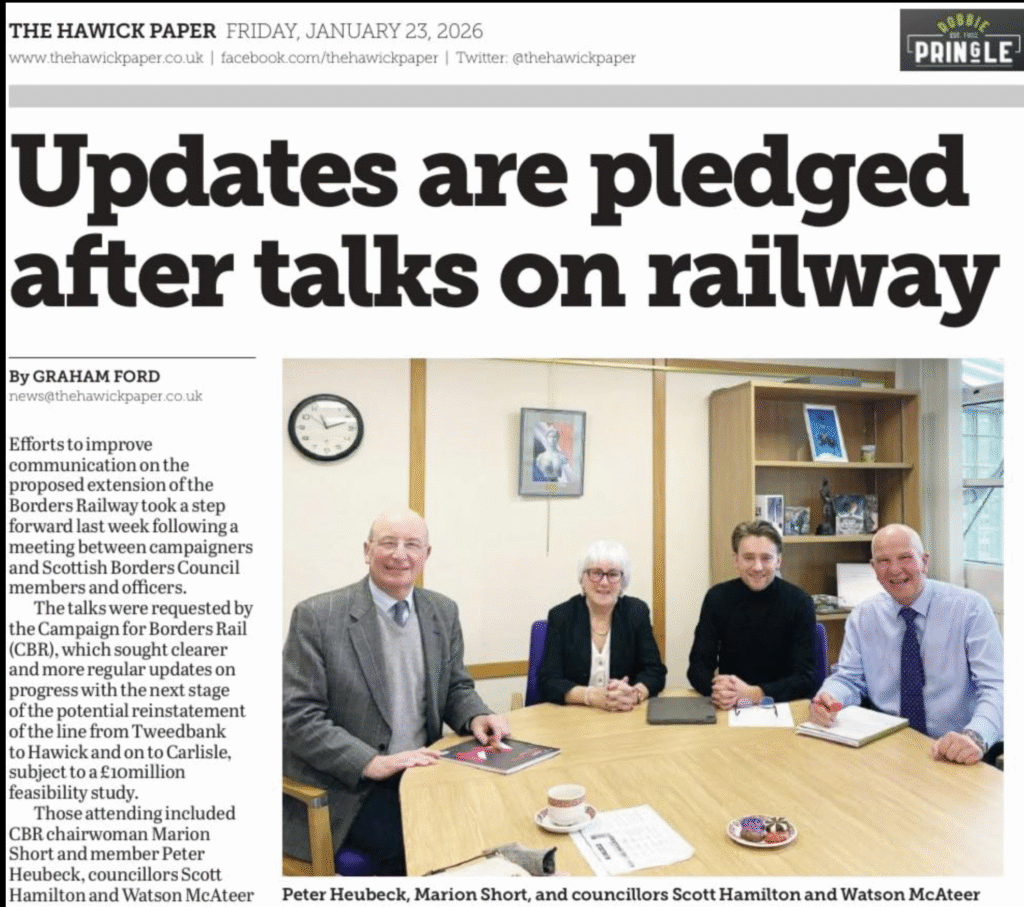
23rd January 2026. Updates on Feasibility Study Progress

Campaign for Borders Rail represented by Marion Short (Chair) and Peter Heubeck (Technical Adviser) met last week with Scottish Borders Council, represented by Councillors Scott Hamilton and Watson McAteer, plus council officers Jenni Craig and Sam Smith.

The aim was to seek clearer and more regular updates on progress regarding the feasibility work being undertaking on to examine the case for extending the Borders Railway to Hawick and completing it south to Carlisle.

It was a successful meeting for both sides. CBR now understands that time was needed to establish how the different requirements of the two government transport agencies could work together. That documentation will be signed off in the next couple of weeks.

Scottish Borders Council affirmed that it considers CBR to be a major stakeholder in the railway project. It was agreed that CBR and SBC would meet quarterly for regular updates.

See today’s Hawick Paper (23 Jan, page 5) for a full report. Available local in shops today or on,ine ny subscription. www.thehawickpaper.co.uk

“

9th January 2026. Tensions emerge over pace of railway study

The front page and page 9 of today’s Hawick Paper (9 January 2025) are devoted to a lengthy piece about what is going on with the Borders Railway feasibility study. Campaign for Borders Rail has tried to find out what progress is being made, but so far without much success.

Both CBR’s Marion Short and Cllr Clair Ramage reiterate the frustration of the Campaign and the public at large due to the lack of any concrete info.

However, there are several pointers in this article which hint at what may actually have been happening.

Cllr Watson McAteer affirms that Scottish Borders Council is committed to the project and is working closely with Turner & Townsend. He says that this first phase is an essential and highly sensitive element which sees the project having to meet stringent requirements set out in HM Treasury’s Green Book.

Cllr Annette Smart understands that ‘initial work’ has already been carried out.

The Scottish Government says it is “committed to keeping the community updated”. But if so, where and when?

The UK Government’s Department for Transport is “working closely with all local parties to finalise the study’s scope”. That sounds like something has actually been happening, though the public haven’t been updated yet.

Cllr McAteer also adds that the ‘external stakeholder group’, which was appointed to monitor and support the public, is meeting this month, with increasing public awareness on the agenda.

So we look forward to receiving some concrete information in the near future.

Buy a paper copy of the newspaper today or subscribe online to read the full article. https://thehawickpaper.co.uk/…/the-hawick-paper-friday…/

“

18th December 2025. Frustration over hold-up to Borders Railway Carlisle feasibility study

As you have probably realised from recent posts on Campaign for Borders Rail’s Facebook page, there’s been a growing sense of frustration that feasibility work hasn’t yet started 8 months after the appointment of consultants to carry out the work.

This article on the BBC website delves into the problem. You may need to register/sign in to access the article.

https://www.bbc.co.uk/news/articles/c9w7q1vxgyxo?fbclid=IwY2xjawPMU6hleHRuA2FlbQIxMQBzcnRjBmFwcF9pZBAyMjIwMzkxNzg4MjAwODkyAAEelRDG2Wz729QLbhxT-8qf1AR8XKrEmV252qwvwesiuyN5rsC9YfVnZj2PJhs_aem_OooYGXmaZwuKBF80hmZMGQ

“

9th December 2025. MP Meets with Rail Campaigners

Carlisle MP, Julie Minns, has met with representatives of the Campaign for Borders Rail to discuss extension of the Borders Railway south to Carlisle.

She said: “Having seen how successful the reopened line between Edinburgh and Tweedbank has been over the last decade, I am keen to understand what the viability study will say about the benefits of reopening the line north of Carlisle might be for North Cumbria and the Borders.”

Read more at:

https://www.newsandstar.co.uk/news/25680951.mp-meets-group-campaigning-reopen-borders-railway-line/?fbclid=IwY2xjawPMVNZleHRuA2FlbQIxMQBzcnRjBmFwcF9pZBAyMjIwMzkxNzg4MjAwODkyAAEeLhKiYnJEK5haAq9BNcv_bTavRrrRKAhfZ9Iq3BY0ciqWVxE9MC6xFnm_qQM_aem_ouThrNsGBc38iQolj3NCtQ

“

2025 AGM- Guest Speaker Hugh Wark

“Campaign for Borders Rail AGM – Resumé of Hugh Wark’s presentation

Hugh was Network Rail’s Project Director for the Borders Railway project. He is an immensely experienced railway civil engineer whose long career had spanned British Rail, Railtrack and Network Rail. The Borders Railway was Hugh’s last project before retirement. Immediately prior to leading that project, he had managed the upgrading of the West Coast Main Line in Scotland for the Pendolino tilting trains and the Airdrie to Bathgate reopening project.    

Extending the railway – having examined the course of the old railway from Tweedbank to Newtown St Boswells, Hugh commented that none of the problems, including those at Melrose, are more severe than those which were successfully overcome constructing the railway to Tweedbank. More generally, two helpful factors are that mine workings are not present south of Tweedbank and there has been very limited infilling of old cuttings.  Hugh also commented that, in his view, Hawick would probably be the outer limit of a half-hourly service from Edinburgh and that any service south from Hawick would probably be hourly.  

Project planning – good planning and activity sequencing is essential. The client, the principal contractor and key sub-contractors must develop detailed plans which are all aligned, continually refined, reviewed and updated. The use of an “early contractor involvement”, (ECI) contract with BAM Nuttall was important, because it accelerated the development of robust implementation plans.  

Risk mitigation – conducting quantified risk assessments of what could go wrong, (in terms of safety, cost, time and quality) and implementing mitigation measures is vital. 

Legal powers – the Waverley Railway (Scotland) Act gave NR extensive powers, but also placed a very large number of constraints on what could be constructed and how, (including temporary works and legally-binding undertakings to neighbours). Only limited design work had been done prior to the Act, so some of these constraints were challenging. The Act conferred outline planning consent, but specific detailed consent had still to be sought from the relevant local authority.  

Seasonal constraints – some species can only be disturbed or relocated at certain times of year and it is inadvisable to undertake major earthworks between October and April because the ground is too wet. These constraints must be factored into the project plan.

Project scale – this large project was divided into sensibly-sized “packages”, with dedicated teams and support bases on each. 

Build and repair – in addition to constructing some spectacular new structures, a very large number of old steel, masonry and brick bridges, (and two tunnels) were repaired. Although some old structures records were available, many could not be traced.  

Mine workings – in Midlothian, a large number of mine workings which were close to or directly under the railway had to be made safe. Some of these were uncharted and were only discovered once work had commenced. Some workings could not be conventionally infilled, (by pumping in large quantities of grout), because they carried flows of mine water, so complex technical solutions works were required. Large scale resources from specialist contractors were deployed for this work. Until mine workings had been remediated, they created a “dead” area, which could delay other important work.  

Infilled cuttings – various cuttings had been infilled, in some cases with domestic refuse. At Shawfair the route of the railway had to be excavated through large quantities of colliery spoil. These works were costly and time-consuming. 

Materials movements – large quantities of newly-quarried aggregate were required and excavation works also generated unusable spoil which had to be disposed of. Managing the logistics and cost of these materials movements along the route was a key skill.

Earthworks strengthening – many cutting slopes had to be strengthened by regrading and adding stabilising aggregate, especially on the long southbound climb to Falahill summit. 

Highways work – the project included a large amount of highways work, both permanent alterations and temporary diversions. Large scale works were undertaken at the Edinburgh City Bypass and at Falahill. 

Some surprising challenges – among the large quantity of buried services which had to be diverted, one BT fibre cable was a real challenge due to the long lead times and special conditions which had to be met. The hilly terrain posed difficulties for establishing safety-critical radio communications between train drivers and the signalling centre.  Providing power and data services to the new stations posed challenges, especially with the volume of road excavations for cable laying. 

Galashiels – complex works were required in Galashiels to thread the railway through the narrow corridor available, to raise the level of the railway over new road under-bridges and to excavate infilled cuttings. 

Communications – good communications within the large project team and with a large number of regulators, stakeholders and local communities was essential. Trust had to be earned and the team worked hard to be open and honest in their communications. For example, even minor breaches of environmental conditions were immediately reported to the relevant agency.  

Fit for purpose – the railway was designed to meet a particular specification, ie a half-hourly passenger service operated by relatively lightweight multiple units, (heavy locomotive-hauled trains can operate, but only under special conditions). While the combination of single and double track is a constraint, it was selected as the most economical way of meeting the specification. In response to a question, Hugh commented that he thought it unlikely that a strong business case could be made for more double track and pointed out that the easier option would be to operate longer trains of up to six carriages.